
Popular
Popular


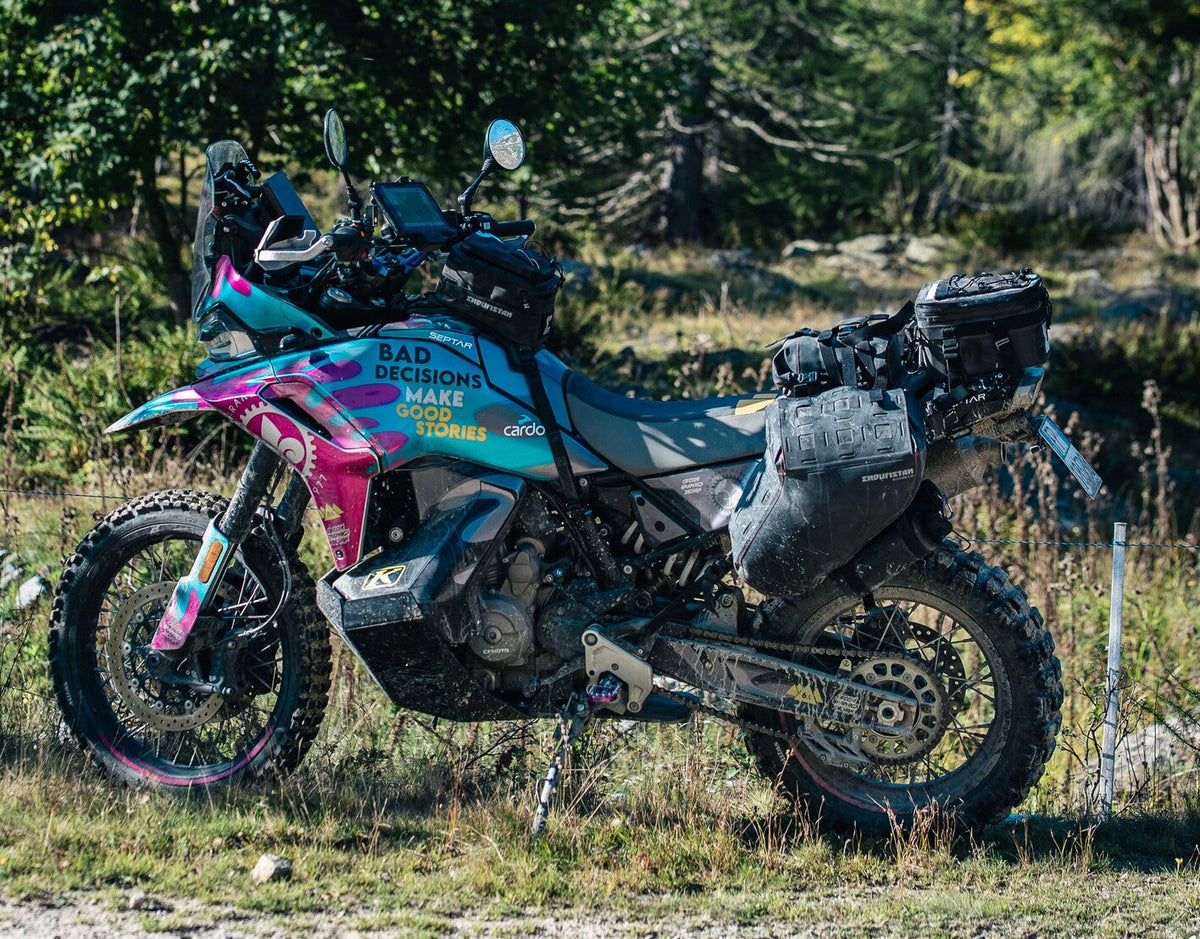
Wondering how to keep water, sand, dust and mud out of your luggage on your rides? Then you broadly have two options: roll-tops or zips.
It might seem like a strange place to start: what about brands, materials, seams and so on? But here is why: closures are literally the gatekeepers of your luggage. Your motorcycle bags can be as high-quality as you like, but if the closures do not seal properly, water will get in sooner or later.
Roll-tops are waterproof and dustproof because they create a mechanical seal. The rolled and compressed layers leave no room for water, fine dust, mud, road dirt or sand.
Zips, on the other hand, can be a weak point, unless they are fully waterproof or given extra protection by, for example, an inner lip or flap. Even then, good maintenance is important to keep the zip reliable.

So in this blog we take a thorough look at the different closure systems on motorcycle bags. Because it is the details that make the difference. Especially when you are on day 45 of your trip, it has been raining non-stop for a week and you are trying to make your way along a remote trail that has turned into one big mud pool.
The basics
A simple truth: a zip is a moving seam. A roll-top is a folded wall.
Water, fine dust, sand, mud and dirt are all sneaky intruders looking for the smallest gaps to get into your luggage. Your panniers, duffel bags, tank bags and backpacks all have to deal with the weather and the terrain your bike and gear have to get through. And it is not just about bad weather or fesh-fesh, also known as bulldust, the kind of powdery sand you would rather stay well away from.
Think too of spray from your tyres, wear from crashes, and days of riding through mud with no chance to clean your boots, let alone your luggage. Add water crossings, engine vibration and the build-up of sand, silt and grime. In short, there are dozens of factors involved in keeping your gear fully waterproof and dustproof.
Roll-tops
Let's start with roll-tops, because they may be the least spectacular solution, but also the most reliable. A roll-top is essentially the equivalent of a vault door for your luggage. Not because it is complicated or special, but simply because physics does the work.
When you roll the top three or four times and then fasten it firmly, you create a series of compressed folds. Those folds form a kind of geometric maze, rather than one straight line along which water can easily run in. Dust and sand have the same problem. They cannot just make their way in. They have to work their way through pressure, friction and multiple layers of folded material.
In short: roll-tops do not depend on a delicate mechanism. They rely on geometry and physics. Again, not very exciting. But that is exactly why it works.

That is why roll-tops are the standard choice for the motorcycle bags that take the most punishment. Think of panniers and duffel bags that are constantly exposed to spray, mud and everything your rear tyre, or your own overconfidence off-road, throws at them.
Want to see how this principle is applied in practice? This is exactly the thinking behind roll-tops like those on the Hailstorm, Blizzard and Monsoon Evo. These are bags designed to do their job completely reliably, while you concentrate on staying upright in a riverbed.
Roll-tops are ideal when:
Put simply: if your bag takes a beating, a roll-top is your best friend.
Roll-tops are reliable, but of course they are not magic. Most "my roll-top leaks, I want my money back" stories eventually come down to: "I didn't close the bag properly."

If you want to remember one simple rule: roll-tops reward riders who do it right once and punish riders who always want to do it quickly.
So take those few extra minutes to make sure your luggage is not overfilled, the edges of the roll-top line up perfectly and you roll it three or four times. Make it second nature. You will thank yourself later. In fact, you will probably feel a little smug about it. And we are absolutely fine with that.
Zips
Zips are not unreliable in themselves. They are just... rather ambitious. They promise convenience in an environment that is not exactly asking for it.
A zip is a closure you can open with one hand, even wearing gloves and while muttering a few choice words. That is why we all love them on compartments you need quick access to, such as tank bags and certain storage pockets. But a zip is also a mechanism with moving parts, friction and a long, narrow line where the outside world is in direct contact with your gear.
And that outside world is not always friendly. Certainly not when you ride through different climates, terrain and weather, fall over now and then, or decide to find out how deep that puddle really is and then discover it is actually a bog.
To be honest, there is really no such thing as a fully waterproof zip for motorcycle bags, unless you switch to diving gear. Many brands, and even zip manufacturers, call their zips waterproof. And on a hike that may well be true. But when raindrops are being fired at your zip at 120 kilometres per hour, it is a very different story.
Really heavy-duty waterproof zips, like the ones on our Hurricane backpacks, are so stiff to operate that they can drive you mad. And if you do not clean and lubricate them regularly and properly, they will eventually give up. And yes, we are talking about the zips, not the people.
For tank bags, where you often need quick access to your things, we use zips that are technically waterproof. But we add a second barrier. Because "technically" simply is not good enough.

So yes, waterproof zips can work well. But they do need two things:
This is what happens in practice:
If you want to use zips on motorcycle bags, the smartest approach is simple: do not rely on the zip alone.
That is why zip designs that hold up well in practice often have a second barrier. Think of an inner lip, gutter, flap or protective layer that stops water and dust getting further in, even when the zip is under heavy load.
Take our Sandstorm tank bag, for example. It has a sturdy zip, but that zip is part of the system, not the whole system. On the inside of the Sandstorm there is a protective lip designed to keep water and dust at bay.
But just like lining up the folds of a roll-top and maintaining a zip, it is important to keep the inner corners nice and straight. If you do not, water will eventually find its way in after all.

Zips are a good choice when:
Waterproof zips are definitely a good solution for certain products. Think of a backpack like the Hurricane, where a truly waterproof zip is part of the design. After all, you do not drag a backpack like that behind your rear tyre through a riverbed. If you do, that is a personal choice, not a design flaw. Just saying.
That zip is a pretty tough customer, by the way. That is why we strongly urge you to clean and lubricate it regularly and generously.
Want your zip to keep doing its job?
Zips are not fragile. They are just honest. They show exactly how much abuse and neglect you put them through.
Choosing
This is where it sometimes gets a little strange. People choose a closure as if it were a statement.
Don't.
Choose a closure the way you choose tyres: based on the conditions, the possible consequences and how often you need access to your luggage.
| Use | Exposure to spray, mud and submersion | Quick access needed | Best closure | What to look for |
|---|---|---|---|---|
| Panniers (touring + off-road) | High | Low to medium | Roll-top | Enough material for 3 to 4 rolls, sturdy straps and a simple closure |
| Duffel bags / tail bags | High | Low | Roll-top | Good compression and a sturdy strap system |
| Tank bags | Medium | High | Protected zip | Sealed zip + second barrier (inner lip/flap) and a smart corner design |
| Backpacks | Medium | High | Waterproof zip or roll-top | With a zip: a truly waterproof zip and clear maintenance instructions |
Many of the best luggage designs combine both systems:
That is not indecision about which closure to choose. It is simply thoughtful design that takes into account how people actually travel.

Preventing leaks
Want to avoid discovering this on day 45, in the pouring rain? These are the classics:
Standing in a shop, or looking at product photos online in the middle of the night? Look for:
Want to know exactly what makes soft luggage waterproof, beyond the closure? Think seams, construction and materials. We explain it in detail in our blog No Rain Covers, No Excuses. Closures are the gatekeepers, but they are not the whole castle.
In practice
Want to see how roll-tops behave when a trail turns into a wet battle with gravity? Reviews from other riders are the best way to look beyond marketing stories.
Finally
Roll-tops are the best choice when conditions are tough and your luggage is fully exposed to the elements. Zips are ideal when you need quick access to your things, but only if they are designed for reality and not just for nice catalogue photos.
The goal is not to have the "coolest" closure, or sometimes even the most convenient one. The goal is not having to think about your luggage at all. That way you can focus entirely on the ride: the mud, the kilometres, the occasionally questionable decisions and the fact that you somehow enjoy it enormously.
Waterproof on the road
Explore the roll-top bags for rain, mud and sand, and the tank bags with protected zips.
View all collectionsAny questions?
If they are well designed and rolled correctly, yes. Roll-tops are among the most reliable waterproof closure systems because they create a mechanical seal.
Usually 3 to 4 times. Fewer rolls means less compression, fewer barriers and more chance of learning the hard way.
They can be, but they are still a mechanism. They work best when they are genuinely waterproof, well protected by the design and kept clean and well lubricated.
Almost always a roll-top, especially for main compartments. Dust, mud and dirt are merciless on moving parts.
If your luggage is genuinely waterproof and you close the roll-top properly, a rain cover should not be necessary. Read why in No Rain Covers, No Excuses.
Because "waterproof" may refer to the zip material and not the complete system. On top of that, dirt, wear, tension, poor integration into the design and insufficient maintenance can all stop the seal from working properly.
Keep them clean, never force them and lubricate them according to the recommended maintenance instructions, for example with Zipper Lube. See the zip as a functional part of your luggage, not decoration. You maintain your motorcycle too, right? You change the oil, clean the air filter and lube the chain. Treat your zips the same way.
Take something out and move it to an expansion bag, such as a Sidekick on the Standard Interface or a Pannier Topper. That way you keep enough material for 3 to 4 rolls.
Among others the Hailstorm, Blizzard and Monsoon Evo, and the Tornado and Cyclone duffel bags. The Sandstorm tank bags have a waterproof zip with a protective inner lip.
Do not pack them directly against the roll-top, but in a separate waterproof bag. That way you avoid a damp spot by the closure.
Your story
Have you experienced this yourself, or got a question or a tip for other riders? Be the first to share it here.


