
Popular
Popular


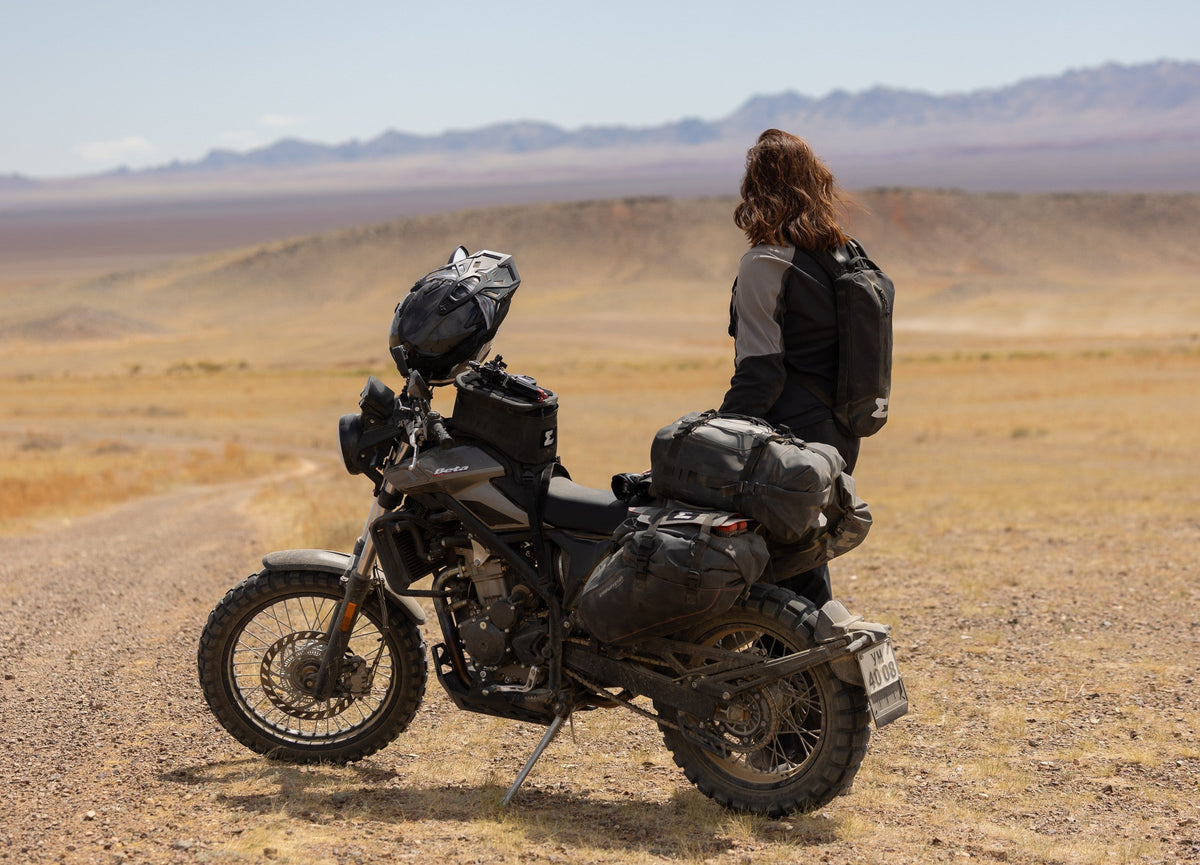
Your indicator goes left. You ride off the tarmac onto gravel and suddenly there is… nothing.
No tarmac, no power lines, no fences, no signs. Just rolling ground, two thumping motorcycles, a herd of unbothered camels watching you go and an endless blue horizon that stretches all the way to the Gobi.
That is how Mariella and her partner Philipp began their two-week motorcycle expedition through Mongolia. They dreamt of galloping wild horses, endless sand dunes and pure off-road freedom. But that dream soon ran into the reality of travelling in a remote country: fuel shortages, blown fuses fixed with a piece of wire, beetles dropping from the ceiling and a serious test of mindset and self-confidence.

When things in the wilderness go differently than planned, the real journey begins. We talked to Mariella about desert dust, about learning to trust your gut when the tracks get deep and about why turning left off the tarmac changes everything.
The first turn
If you opened this story with one scene from Mongolia, which would it be and why?
Mariella: The indicator goes left. We turn off the tarmac onto gravel and then onto nothing but bare earth. Suddenly there is no road at all. Ahead of us lies the desert, as far as the eye can see. No houses. No power lines. Not a single sign. Just us, the roar of our engines, the endless space and a herd of camels watching us pass.
We rode straight towards that huge blue sky, with no idea what the landscape would look like a few metres further on.
That moment sums up how Mongolia felt to us: an amazing sense of freedom, the thrill of the unknown and the realisation that here you never know what lies round the next bend. If there is a bend.
How did Mongolia feel on day one? What did you see, hear and smell?
Mariella: Our first introduction was at half past four in the morning, in a taxi from the airport to the hotel. I remember staring out of the window, trying to take it all in: green hills, the first traditional gers and Mongolian music on the radio. As we got closer to Ulaanbaatar, the landscape suddenly turned into skyscrapers and giant statues of Genghis Khan.
But if you ask me what Mongolia smells like, I immediately think of the moment we left the city behind and rode into the wilderness. There was an intense, wild scent in the air: herbal, floral and a little earthy. I had never smelled anything like it and it suited the landscape perfectly.

The plan
What did the dream version of this trip look like while you were planning it?
Mariella: I had a lovely romantic picture in my head: riding across endless plains, with wild horses galloping beside me and a magnificent eagle overhead. Pure, wide-open space.
My partner Philipp saw it a little differently. He wanted two weeks of pure riding where, unlike in Europe, you don't have to hunt for legal off-road routes. In Mongolia it is exactly the other way round: with a bit of luck you come across a paved road now and then! Riding through sand dunes had been his dream for years and in the Gobi he finally got the chance.
And the planned route?
Mariella: A two-week loop from and back to Ulaanbaatar. We wanted to head south into the Gobi, swing west and then return north through completely different terrain. Past impressive rock formations, white cliffs, deep canyons, huge dunes, ancient monasteries, the volcanic landscape of the Orkhon Valley, hot springs and mountain lakes.

Fuel shortage
When did fuel go from a practical detail to a real problem?
Mariella: Before we arrived we hadn't heard anything about a fuel shortage. But during that first taxi ride at sunrise, Philipp noticed long queues at every petrol station. When we picked up our rental bikes, the rental company confirmed it: we were given two extra jerrycans and advised to buy a siphon hose, so that in an emergency we could ask passing vehicles for fuel. They also warned us that petrol stations were no longer filling jerrycans.
We tried to stay optimistic: surely it wouldn't be that bad?
That optimism soon vanished as we rode out of Ulaanbaatar, past queues at petrol stations kilometres long. When the first three stations we reached were completely empty, reality hit hard.
Describe the moment it became clear you couldn't go on on two wheels.
Mariella: That was at the end of our Gobi loop, at a ger camp close to the Khongoryn Els dunes. Our spare jerrycans were empty, the bikes' tanks almost too, and our host spent hours phoning villages along our route. The only thing he could confirm: there was no petrol anywhere further on.
We remembered an Australian and a Belgian we had met in Dalanzadgad. They were travelling by car and were completely relaxed: "We've got a diesel. No problem, we just skip the queues."
We called our rental company to ask if we could switch to a diesel 4x4. Carrying on with the bikes was impossible without getting stranded in the desert. We had to turn back.
Turning round felt like giving up before we had experienced everything we had dreamt of. I was frustrated, disappointed and felt as if we had failed. One thought kept running through my head: Challenge not accomplished. It sounds silly now, because it was the only sensible choice. But at that moment it felt as if Mongolia was challenging us and we were running away.

From two wheels to four
What was it like to swap handlebars for four wheels? What did you lose and what did you get in return?
Mariella: Above all we were relieved that we could carry on. If horses or yaks had been our only option, we would probably have jumped at it!
A car has clear advantages: you throw your gear in the back without puzzling over how to pack it, and you can take as much food as you like. But we missed the raw sense of freedom straight away. On a motorcycle you don't just ride through a landscape, you are right in the middle of it. You feel the temperature drop, smell the earth and feel intensely how big the world is.
And the funny thing is: you would think a car is more comfortable, but on Mongolian "roads" we were thrown from side to side and bounced against the roof. On the bikes we were actually far more comfortable!

Did being on a motorcycle or in a car make a difference to how local people treated you?
Mariella: Hugely. On a motorcycle you aren't just a tourist looking through a window, you feel like a fellow traveller. Oncoming drivers flashed their lights and waved, and every stop led to spontaneous conversations.
My best memories are of the local children and teenagers who came running up with big grins, asking if they could sit on the bike or ride it for a bit. That created an instant connection, even without a shared language. In the car that magic was gone. We became spectators looking in from the outside. On two wheels everything is closer and more personal.

On the road
What was the funniest "this is completely absurd" moment?
Mariella: When we picked up our brand-new Beta motorcycles in Ulaanbaatar, the rental company casually mentioned that one bike had an electrical fault that kept blowing fuses. Their solution? They handed us a little bag of spare fuses and wished us good luck. Two motorcycles, a bag of fuses and the Gobi. (Of course we left that bag behind in a hotel and in the end fixed the wiring on the road with a piece of wire from a Mongolian man who helped us.)
Then there were the nights in the gers. Wonderfully quiet until it got dark. Then hundreds of black desert beetles crawled out of the floor, climbed up the walls and dropped from the ceiling onto our blankets all night long, with a steady click... click... click. The next morning every beetle had vanished without a trace.
And then there was the time we ran out of drinking water by the dunes. Using a translation app, we asked our host for water. He came out of the kitchen smiling and nodding, carrying a rusty, open bucket of water. We laughed about it… until our stomachs started making suspicious noises a few hours later.
Mindset
What did this ride teach you about your own limits?
Mariella: Trust your gut and take a break in time. You don't have to prove anything to anyone.
I had little off-road experience before this expedition, so Mongolia pushed me far outside my comfort zone. Deep sand with the bike squirming beneath me, steep rocky climbs, deep river crossings: every time I came to a tricky section, that voice crept in: Can I really do this? Am I strong enough?
Out there your biggest opponent is hardly ever the weather or the terrain, but your own head telling you to give up. Every difficult river or sandy track I got through gave me a little more confidence and made that voice quieter. Sometimes you just have to try. Breathe in, drop your shoulders and go.

The gear
Which piece of gear worked hardest for you, day in, day out?
Mariella: Without a doubt our Hurricane 7 backpacks with the HydraPak hydration bladders. We wore them every day. In the desert sun, drinking enough is a matter of safety. The bite valve sat right under the helmet, so we could drink on the move without stopping. That really made a difference.
Where did your luggage system save the day?
Mariella: As a photographer I need my camera at hand straight away, especially in Mongolia, where the landscape changes every ten minutes. Our Sandstorm tank bags held my camera and drone, right between my arms. The dust in the Gobi really gets in everywhere, but the bags kept it out completely. At the river crossings I knew that thousands of euros' worth of camera gear was staying bone dry. That gave me enormous peace of mind.

And the best part: in Europe we packed our soft luggage into our duffels for the flight, flew to Ulaanbaatar, strapped it straight onto the rental bikes and rode into the wilderness. Tough enough for rough desert use, yet light and flexible enough to fly anywhere in the world.
Finally
What did Mongolia give you that you didn't expect?
Mariella: Self-confidence. Far more than I ever expected.
After we had switched to the 4x4, a local man asked us: "Weren't you terrified, travelling through Mongolia on motorcycles all on your own?" The question caught me completely off guard, because the thought had never crossed my mind. I was unsure about my riding skills, but never about the country or its people.
Mongolia gave me a solid inner strength I didn't know I was looking for.
(Philipp's answer is a lot simpler: camel dumplings.)
If you could give other riders one message, what would it be?
Mariella: It all started with a left turn off the tarmac, and I would take that turn again in a heartbeat.

Follow Mariella and Philipp's adventures on Instagram: @framethe.world
Further reading
Dust out, camera dry
Waterproof tank bags that keep your gear right between your arms.
View the tank bagsAny questions?
A couple who spent two weeks riding rental motorcycles through Mongolia. Mariella is a photographer. You can follow their adventures on Instagram at @framethe.world.
A two-week loop from and back to Ulaanbaatar: south into the Gobi, a swing west and back north through the Orkhon Valley.
Because of a fuel shortage, there was no petrol to be had anywhere in the Gobi. Diesel was available, so they swapped the motorcycles for a diesel 4x4.
Hurricane 7 backpacks with a HydraPak hydration bladder for drinking on the move, and Sandstorm tank bags for camera and drone, dustproof and waterproof.
They packed their soft luggage in duffels for the flight and strapped the bags straight onto the rental bikes in Ulaanbaatar.
Your story
Have you experienced this yourself, or got a question or a tip for other riders? Be the first to share it here.


